Jamlet
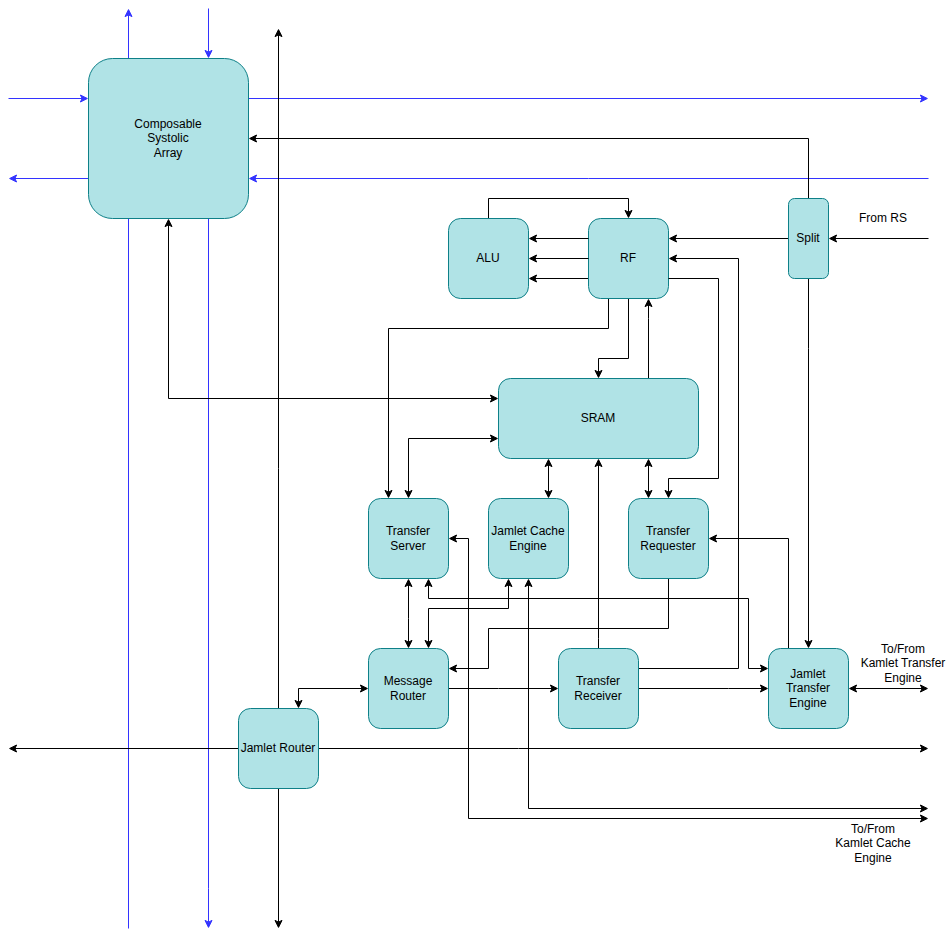
Kinstructions arrive at the Jamlet from the Reservation Station. Non-local kinstructions are placed in the Jamlet Transfer Engine, while local Kinstructions are executed directly.
Splitter
The splitter breaks kinstructions with LMUL>1 into a sequence of configs.
Vector Register File Slice
The Zamlet Vector Register File is distributed amongst all the jamlets in the mesh. Each register file slice has four read ports and one write port. The local operations are guaranteed precedence to the register file ports with deterministic latency, while the non-local operations may be blocked by the local ones.
ALU
The ALU isn't well planned out yet. I'll likely start off by using the implementation from the Saturn VPU and modify it to work in the jamlet.
SRAM
The SRAM is a single-port compiled memory used for storing the jamlet's share of the cache lines. See Cache System. It may also be extended to support use as a scratch pad.
Router
The router connects the jamlet to the jamlet mesh network. This allows the jamlets to exchange messages. Non-local data movement uses the jamlet network.
Message Router
The message router routes packets between the main router and the Cache Engine, Transfer Requester, Transfer Receiver, and Transfer Server.
Jamlet Cache Engine
This module is controlled by the Kamlet Cache Engine and is responsible for reading the local SRAM and generating packets to send cache lines to the Memlet, and receiving packets from the Memlet and using them to update the local cache line in the SRAM.
Jamlet Transfer Engine
This Jamlet Transfer Engine keeps track of the jamlet-specific state of Non-Local Kinstructions. Below we show a typical entry in the table. It shows the status of each byte in the word.
| Byte | Status |
|---|---|
| 0 | DONE |
| 1 | SKIP |
| 2 | REQ |
| 3 | SKIP |
| 4 | REQ |
| 5 | SKIP |
| 6 | INIT |
| 7 | INIT |
DONE : The processing of this byte is complete. We sent a request and received a response.
SKIP : The byte did not need processing. Here we were operating on 16-bit elements so that the byte 0 entry took care of both bytes 0 and 1.
REQ : A request has been sent but no response received.
INIT : The Transfer Engine has not started processing these bytes yet.
More details can be found in the Transfer System section.
Transfer Requester
The transfer processes an entry from the Jamlet Transfer Engine along with the corresponding entry from the Kamlet Transfer Engine. Using this information it generates packets to send to other jamlets. It may read both the register file and the SRAM to obtain data for the packets.
Transfer Receiver
This module receives the responses from the other jamlets to the transfer requests. Based on the content of the packet it will update either the local register file or SRAM, and will update the Jamlet Transfer Engine state.
Transfer Server
The Transfer Server is responsible for processing the transfer requests from other jamlets and generating the transfer responses. Based on the content of the message the server will read the register file, read the SRAM, or write the SRAM, and then generate a response message. Before accessing the SRAM the Transfer Server will query the Kamlet Cache Engine to determine if it is a cache hit or miss and to get the cache slot. If it is a cache miss then the Kamlet Cache Engine will begin fetching the cache line, and will store details of the request until the cache line is available. Once the cache line is available it will send the request information back to the Transfer Server so that the server can generate and send the response.
Composable Systolic Array
The jamlet contains a composable systolic array for matrix-matrix multiplications. It's not particularly well thought through yet. The array has a toroidal topology and can be connected to the arrays of neighboring jamlets to produce a toroidal systolic array of larger dimensions.
It contains buffers where inputs and outputs to the operations can be gradually written and read. The bandwidth into and out of these buffers is much lower than the speed at which a single systolic array can consume them, however when multiple systolic arrays are combined into a large array the input/output bandwidth and computation is balanced.
See Systolic Array.
The details of the required custom instructions for this hardware have not yet been designed.