Lamlet
The microarchitecture of the lamlet is less well thought through than the kamlet mesh. Because it will be a small fraction of the area it's less critical that it is well-optimized and it just needs to be feasible. Performance of the frontend is important since it works in lock-step with the processor, while performance of the backend is less important since latency will be dominated by the kamlet mesh.
Lamlet Frontend
Pipelined Fault Checker (PFC)
Works out which pages the vector instructions access and faults. This section runs in lock-step with the processor pipeline. I'm hoping I can reuse the implementation from the Saturn VPU from UCB. There will be some vector instructions where it is not possible to determine whether the instruction results in a page fault in the frontend. These instructions will be passed to the backend and the pipeline will be stalled until it is known whether there is a fault. This is different from the saturn VPU implementation which had an iterative fault checker in the frontend to handle these cases.
Scalar Checker
This module is responsible for keeping track of which scalar memory pages the vector processor has in-flight reads or writes to. If the scalar processor tried to make a conflicting read or write then the Scalar Checker will stall the processor until the VPU has finished accessing the scalar memory.
TLB
The Translation Lookaside buffer keeps a cache of the page table, as well as a cache of lane orders and EW of memory stripes. The kamlet TLBs will query it over the kamlet network when they have a miss.
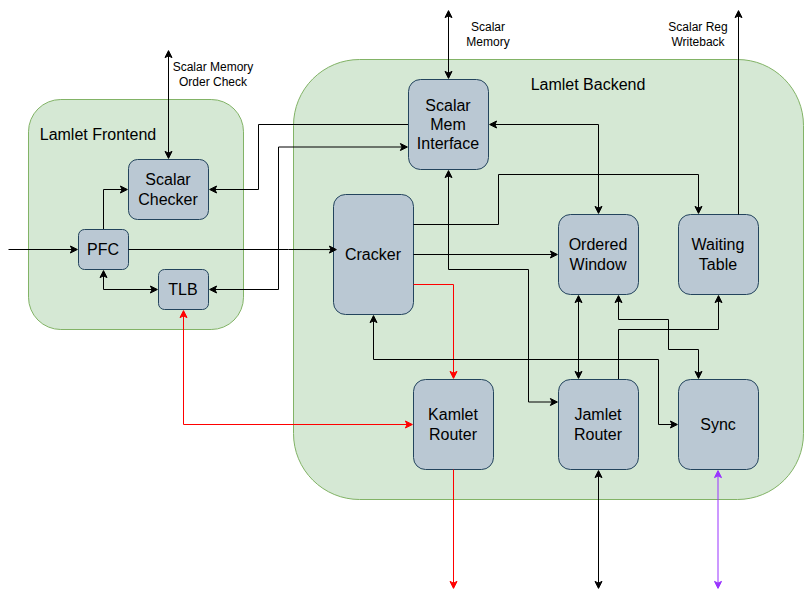
Lamlet Backend
Cracker
The Cracker breaks the sequence of vector instructions from the frontend into a sequence of kamlet instructions to broadcast to the mesh of kamlets (we abbreviate kamlet instructions as kinstructions). The module will know the lane order and element width of all the vector registers and pages, and will insert additional kinstructions to perform remappings of registers to compatible orderings when necessary. It will also split complex instructions, such as a reduction, into a sequence of simple kinstructions.
During this cracking additional temp vector registers will often be required to store intermediate results. Zamlet has 48 logical registers: the 32 architectural vector registers and an additional 16 temp vector registers. Because the number of physical registers is limited (probably 48-64) the Cracker adds kinstructions that free the temp registers once it is done with them, allowing the slots to be available during renaming.
Once the kinstructions are created they are sent to one or more of the following:
- 1) Kamlet Router
- 2) Waiting Table
- 3) Ordered Window
The Cracker also keeps track of available space in kamlets instruction buffers, available kinstruction identifiers and available synchronization identifiers. This is all done by the insertion of IdentQuery kinstructions into the stream, and the processing of the synchronization responses.
Kamlet Router
The kamlet router connects to the kamlet mesh network. This is used to broadcast the kinstructions to the kamlet mesh.
Lamlet Waiting Table
Some kinstructions require the lamlet to be involved in the processing. If the kinstruction writes to a scalar register the lamlet needs to store the kinstruction until the response comes back from the kamlet mesh. Relevant packets from the mesh are received by the Jamlet Router and these are combined with the Waiting Table state to create scalar register writebacks that are then sent to the processor.
Ordered Window
The Ordered Window module is responsible for handling ordered indexed stores and ordered float reductions.
The ordered window can work on two ordered instructions in parallel, and have up to 16 elements in flight for each instruction at a time.
Ordered Indexed Stores
For stores the ordering is more important since two elements can be written to conflicting addresses. Similarly to loads the Ordered Window first waits for a synchronization point to be reached. The Ordered Window module tracks 16 elements in parallel. The jamlets will respond with messages that tell the lamlet the address, the data, the mask bit and any faults. The lamlet will then send messages to write the memory in the correct order itself.
| Element Index | Note | State |
|---|---|---|
| 48 | GETTING ADDRESS | |
| 49 | Most Recent | NOT STARTED |
| 34 | Oldest | WRITING DATA |
| 35 | COMPLETE | |
| 36 | COMPLETE | |
| 37 | WRITING DATA | |
| 38 | WRITING DATA | |
| 39 | GETTING ADDRESS | |
| 40 | WAITING | |
| 41 | WAITING | |
| 42 | PAGE FAULT | |
| 43 | QUIT | |
| 44 | QUIT | |
| 45 | GETTING ADDRESS | |
| 46 | GETTING ADDRESS | |
| 47 | GETTING ADDRESS |
The diagram above shows an example of an Ordered Window instruction state. The 16 in-flight elements are tracked. The two oldest elements with indices of 34 and 35 have been completed. Elements 36 and 37 have submitted writes to memory, but no write completed response received yet. Element 38 is still in the process of getting its addresses and data from the relevant jamlet. Elements 39 and 40 have received their addresses and data but have not submitted writes since they are waiting to see whether element 38 has a page fault or a conflicting address. Element 42 has already received a Page Fault response back from its jamlet. Elements 43 and 44 have terminated since we received the address, but don't want to do the write when an earlier element has a page fault. Elements 45 to 48 are still getting addresses from the jamlets, and element 49 hasn't yet started.
Ordered Float Reductions
Ordered float reductions are done in a similar way. Elements are given slots in the table and messages are sent to the jamlets to retrieve the data. Once the oldest slot has received the data it is summed into the total and the slot is freed for the next element.
Scalar Memory Interface
This module is the bridge that enables the vector processor to read and write to the scalar memory. It receives requests from the Jamlet Router (jamlets can send messages directly requesting reads or writes to the scalar memory), and the Ordered Window. Loads are directly forwarded to the memory system. For Stores it first waits for the processor store buffer to empty. Here I'm just doing what the saturn VPU does. I don't understand how this guarantees correct order, but assume that if I'm interfacing with shuttle in the same way then it will be correct.
Jamlet Router
The jamlet router connects to the jamlet mesh network. This enables jamlets to communicate with the Scalar Memory Interface, the Waiting Table and the Ordered Window.
Synchronizer
A synchronizer connects the lamlet to the synchronization network. This is used by the Waiting Table and the Ordered Window to reach synchronization points where all kamlets are guaranteed to have processed a kinstruction. It is also used by the Cracker to receive IdentQuery responses.