Transfer System
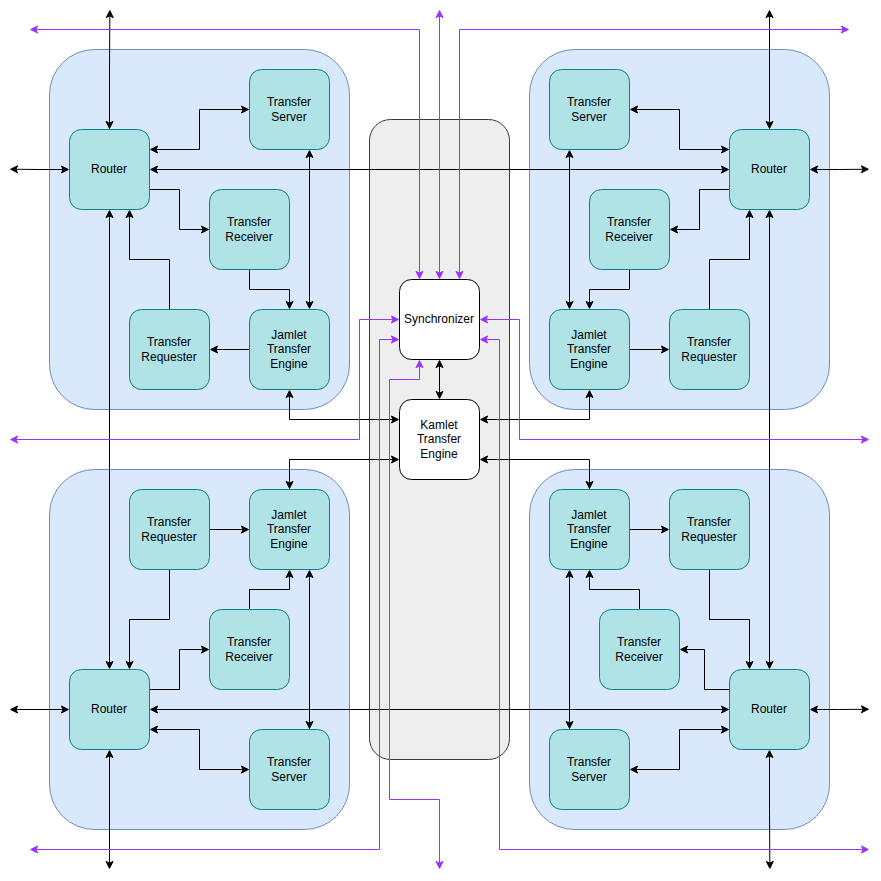
The transfer system is responsible for carrying out non-local data movement between jamlets. All movement is initiated by the Kamlet Transfer Engine. This receives non-local kinstructions and stores them in an internal table of depth 16. Each entry in the Kamlet Transfer Engine table also has an entry in each of the Jamlet Transfer Engine tables with the specific state of the transfer.
The Transfer Requester uses the state from the kamlet and jamlet tables to generate request messages to other jamlets. Depending on the type of transfer these messages are either received by the Transfer Server or the Transfer Receiver. If the message is received by the Transfer Server then the server makes appropriate reads and writes to that jamlet's register file and memory and then sends a response message back to the originating jamlet. If a cache miss occurs then the message is stored in the Kamlet Cache Engine until the cache is available and a response can be generated.
This response is then received by the Transfer Receiver on the originating jamlet (or for some transfer types the original request is received by the Receiver), and the receiver uses the content to update its local register file or cache, and then lets the Jamlet Transfer Engine know that the response has been received.
Once all responses have been received the Jamlet Transfer Engine lets the Kamlet Transfer Engine know and the synchronizer to synchronize all kamlets before removing this kinstruction. If the kinstruction is removed before other kamlets have completed the kinstruction then correct memory ordering is not guaranteed.
Stored State
Kamlet Transfer Engine Waiting Kinstruction State
16 entries. Used to track sending of requests and receiving of responses. Also used for kinstructions that would be local but have a cache miss.
| Field | Width (bits) |
|---|---|
| Instr Ident | 7 |
| Writeset | 5 |
| Source Coords | 16 |
| Cache Slot | 10 |
| KInstr Details | 24 |
Kamlet Cache Engine Waiting Request State
32 entries. Used to track receiving of requests and sending of responses. Each entry represents the request for a single element. Entries only need to be created for cache misses. For cache misses of writes the write data is not stored. Once the cache line is available a request for retransmission of the data is sent.
| Field | Width (bits) |
|---|---|
| Instr Ident | 7 |
| Writeset | 5 |
| Source Coords | 16 |
| Cache Slot | 10 |
| Jamlet | 4 |
| Source Offset | 3 |
| Offset | 3 |
| Width | 3 |
Jamlet Transfer Engine Waiting Kinstruction State
16 entries. Used to track sending of requests and receiving of responses.
| Field | Width (bits) |
|---|---|
| Byte States | 24 (3x8) |
Examples
Aligned, EW-matching Load/Store with a Cache Miss
If it wasn't for the cache miss, this would be a Local KInstruction. However the cache miss means that it becomes non-local.
-
1) As it leaves the Reservation Station the kinstruction is assigned a cache slot. The Kamlet Cache Engine begins the process of evicting an existing cache line, and retrieving the desired cache line. The kinstruction is stored in the Kamlet Transfer Engine table while the cache line is retrieved.
-
2) The Kamlet Cache Engine sends a message to the Memlet over the kamlet network with the address of the line getting evicted, and the address of the line that will replace it.
-
3) The Kamlet Cache Engine instructs the Jamlet Cache Engines to send the evicted data to the Memlet over the jamlet network.
-
4) The Memlet performs the write and read of the cache lines and then sends the retrieved data back to the jamlets over the jamlet network.
-
5) The Jamlet Cache Engines update the SRAM with the new cache line and signal the Kamlet Cache Engine that the update has been done.
-
6) Once the Kamlet Cache Engine confirms that all jamlets have updated the cache line then it signals to the Kamlet Transfer Engine that the cache line has been retrieved.
-
7) Now that the cache line has been retrieved this is a Local-Kinstruction. The Kamlet Transfer Engine will insert it into the local execution flow from the Reservation Station when there is a gap.
Unaligned or EW-mismatching Unit-Stride Load with Cache Hits
If the load/store is unaligned with the stripe size, or there is an EW-mismatch between the register and memory stripe then the operation is non-local.
-
1) The kinstruction leaves the Reservation Station and is given a slot in the Kamlet Transfer Engine and Jamlet Transfer Engines.
-
2) In each jamlet the Transfer Requester receives the entry from the transfer engine and begins to generate and send the request messages. The Transfer requester can work out which jamlet wants the data that is in its SRAM. It reads from the SRAM and sends messages to those jamlets with the data.
-
4) On each jamlet the Transfer Receiver receives the request, writes the data to the local register file, and updates the state in the Jamlet Transfer Engine.
-
5) Once all required requests have been sent and all expected requests have been received (there may be a separate message for each of the 8 bytes in the word), the Jamlet Transfer Engine will let the Kamlet Transfer Engine know that it has completed.
-
6) Once the Kamlet Transfer Engine sees that all jamlets have completed the synchronizer is triggered.
-
7) When the synchronization completed the kinstruction can be removed. Note that the Transfer Engines can be working on many instructions in parallel, and the synchronization network can have many synchronizations occurring in parallel so these kinstructions can be effectively pipelined.
An Indexed Store with Cache Misses, Page Faults and accesses to Non-Idempotent Scalar Memory
-
1) The kinstruction leaves the Reservation Station and is given a slot in the Kamlet Transfer Engine and Jamlet Transfer Engines.
-
2) In each jamlet the Transfer Requester receives the entry from the transfer engine. For each element to be stored it reads the local register file to get the offset and data, calculates the address and accesses the kamlet TLB to get the page information.
-
If the requester gets a page fault it passes this information back to the Kamlet Transfer Engine and stops processing this entry.
-
If the requester sees that the page corresponds to non-idempotent memory then it lets the Kamlet Transfer Engine know that this element is waiting until we know the global page fault status, and moves on to the next element.
-
If the requester sees that the page corresponds to idempotent memory then it uses the lane order and element width stored in the stripe metadata in the kamlet TLB. The Transfer Requester can now determine which jamlet is responsible for each memory byte, and sends a message to each jamlet with the data to write. It lets the Jamlet Transfer Engine know that the messages have been sent.
-
-
3) Once the Jamlet Transfer Engine sees that the entry has been initialized (all elements have checked the TLB) it will respond to the Kamlet Transfer Engine with the minimum element index that faulted if any.
-
4) The Kamlet Transfer Engine will use the synchronizer to determine what the minimum element index that faulted was across the entire VPU. It then passes this minimum back to all the Jamlet Transfer Engines.
-
5) If the Jamlet Transfer Engine is tracking any elements that map to non-idempotent memory then these elements can now either be marked as complete if their element index is larger than the element index where the first page fault occurred, or they can be marked as free to start if their element index is smaller than that of the first page fault.
-
6) In the meantime many of the sent request messages will have arrived at their destination jamlets and been processed by their Transfer Server. It receives these requests and checks with the Kamlet Cache Engine to see if they are a cache hit or miss. We'll imagine that it is a cache miss. The Kamlet Cache Engine stores the request in an internal table and begins the process of retrieving the cache line as discussed earlier.
-
7) Once the cache line is retrieved the Kamlet Cache Engine sends the request back to the Transfer Server which can now use the data to update the cache line. The server then generates and sends a response packet to let the original jamlet know that the bytes have been stored.
-
8) The original jamlet's Transfer Receiver receives the response and lets the Jamlet Transfer Engine know. Once the Jamlet Transfer Engine sees that all elements have completed it lets the Kamlet Transfer Engine know.
-
9) Once the Kamlet Transfer Engine sees that all jamlets have completed it triggers a completion synchronization event.
-
10) Once the kamlets synchronize the kinstruction can be removed from the table.
-
11) Meanwhile the lamlet will have received both the minimum fault synchronization and the completion synchronization. It uses these to trigger the fault handler (in case of a page fault) and to release any memory locks in Scalar Checker when completion occurs.